


Article by
Jonathan Dier
Jonathan Dier is the owner of A Aable Locksmith, a family owned and operated Locksmith company serving the Naples Florida area since 1979. He has over 35 years experience in the Locksmith and Security industry. A Aable Locksmith specializes in residential and commercial security, focusing on customer satisfaction.
Florida landlord-tenant law on lock changes generally prevents a landlord from changing apartment locks to keep a tenant out without following the legal process required by state law. Florida Statute §83.67 addresses prohibited landlord practices, including conduct that may amount to a lockout.
It’s understandable to expect a landlord to manage a property’s security, but that does not mean a tenant can be shut out of their home. During an apartment tenancy, Florida landlords must make reasonable provisions for locks and keys. An access dispute is different from a sheriff carrying out a court-ordered writ of possession.
This article explains when a lock change may be appropriate, what tenants and landlords should know about keys, and why a lockout cannot replace eviction proceedings. It also outlines how residential rules differ from commercial lease situations, helping you distinguish a hardware or rekeying issue from a legal dispute.
Key Takeaways
- Landlords must make reasonable provisions for apartment locks and keys throughout a tenancy.
- A lock change that denies a tenant access is different from a sheriff enforcing a court-ordered writ of possession.
- Florida law addresses prohibited lockouts, and tenants who are denied access can learn what steps may help protect their rights.
- Understand how residential rules differ from commercial lease terms, and when lock rekeying or hardware work may address a security concern.
Landlord responsibility for locks and keys in apartments
In Florida, landlords must make reasonable provisions for apartment locks and keys throughout the tenancy. Residents need to be able to secure the apartment and use its entry points. A working lock without a usable key may not provide practical access, while a key that turns an unreliable lock may not secure the unit.
Consider a tenant who receives keys at move-in but finds that the front-door lock sticks. The issue is not simply whether a lock is present: it should function, and the tenant should be able to operate it. If a key breaks, goes missing, or stops working, the tenant and landlord need to address the access problem while the tenancy continues.
Apartment access can involve more than the front entrance. A unit may have a second exterior entry, such as a sliding glass door, with its own locking hardware. That point matters when assessing whether the apartment’s locks and keys provide practical security. Residents considering the hardware on a patio entrance can review sliding glass door lock security as one part of the apartment’s overall access setup.
For a clear record, tenants and landlords can track the following details:
- Which apartment doors have locks, including any secondary exterior entry.
- Which keys operate each lock and who received them.
- Whether a key turns smoothly or a lock sticks, jams, or fails to latch.
- When a tenant reports a damaged lock or a missing key, and what access issue resulted.
A written record helps distinguish a hardware problem from a disagreement about possession. A tenant reporting that a key will not turn, for example, is describing an access issue. The landlord should distinguish that report from a request to deny someone entry. The obligation to make reasonable provisions for locks and keys applies throughout the tenancy, not only at move-in.
Not every lock change is the same. A repair or replacement that restores reliable access differs from changing a lock to exclude a tenant. The purpose of the change, the tenant’s ability to enter, and whether the tenancy is ongoing all matter. Keeping key and access details organized gives both parties a clearer basis for discussing the problem.
Lockouts compared with writs of possession
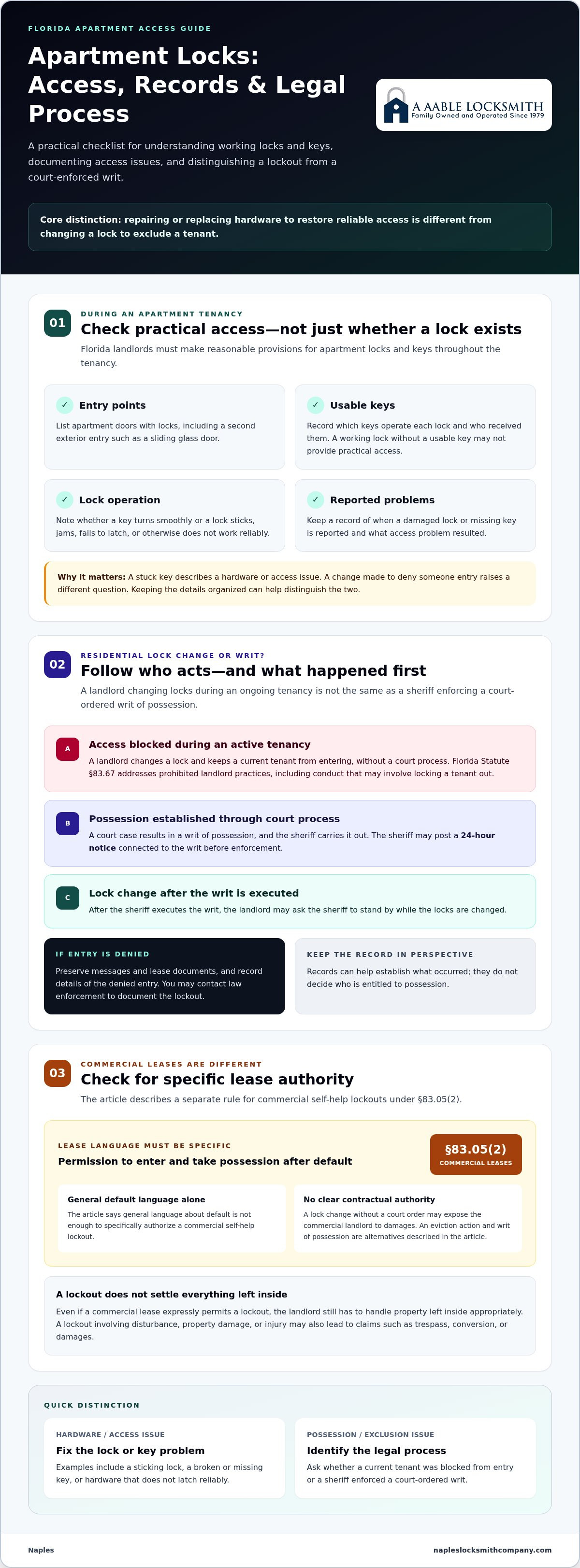
A landlord changing an apartment lock to exclude a tenant is not the same as a sheriff enforcing a court-ordered writ of possession. For a Naples renter, Florida landlord tenant law lock changes must be understood in light of the legal process behind the change. While a tenancy continues, landlords must respect the tenant’s peaceful possession and cannot interfere with their use of the property.
A writ of possession follows a court case. If the court grants possession to the landlord, the sheriff carries out the writ. The sheriff may post a 24-hour notice, leaving a tenant with little time before enforcement. That notice is tied to the writ, not simply to a landlord’s decision to replace a lock. After the sheriff executes the writ, the Florida Legislature says a landlord may ask the sheriff to stand by while the locks are changed. Once possession is finalized and the locks are replaced, property owners managing leftover items often look for junk removal near me to efficiently clear out the space.
For tenants, the practical distinction is who is enforcing the change and what happened beforehand. A landlord changing locks during an ongoing tenancy raises a different issue from a sheriff acting after a court has granted possession. If your key no longer works, preserve messages, lease documents, and details of the denied entry. You may also contact law enforcement to document the lockout. These records help establish what occurred, but do not decide who is entitled to possession.
- A landlord changes a lock and blocks a current tenant from entering, without a court process.
- A court case results in a writ of possession, followed by the sheriff’s enforcement.
- The sheriff posts a 24-hour notice connected to the writ before carrying it out.
- After execution, the landlord may ask the sheriff to stand by during a lock change.
Commercial leases raise a separate question. Under § 83.05(2), a commercial landlord’s self-help lockout must be specifically authorized by the lease, including permission to enter and take possession after default. General language about default alone is not enough. Without clear contractual authority, a lock change without a court order may expose the landlord to damages. Commercial landlords can instead pursue an eviction action and seek a writ of possession.
Even when a commercial lease expressly permits a lockout, changing the locks does not settle what happens to property left inside. A landlord still has to handle that property appropriately. A lockout involving a disturbance, property damage, or injury may also lead to claims such as trespass, conversion, or damages. These commercial lease issues are distinct from a residential writ carried out by a sheriff. The key question in Florida landlord tenant law lock changes is whether a court process established possession or a lock change simply blocked access.
Prohibition on changing locks to deny a tenant access
Florida law restricts landlord actions that block a residential tenant’s access, while lease-end possession follows a different process. The distinction matters when a lock change happens during an active tenancy.
Lock changes that deny tenant access
A lock change becomes a lockout when a landlord uses it to prevent a tenant from entering an occupied rental home. Florida Statute §83.67 addresses prohibited landlord practices, including conduct that may involve locking a tenant out. For example, replacing a unit’s lock and withholding working keys can interfere with a tenant’s access. A tenant who finds entry blocked can document the changed lock, preserve messages, and contact law enforcement to record the denial.
Tenant lock changes and landlord permission
The prohibition on landlords locking out tenants does not give tenants blanket authority to change rental locks without permission. Before installing a new lock, review the lease and seek the landlord’s written approval. This matters if the change affects the landlord’s access or leaves other occupants without working keys. If you need a safety-related change, keep the request and response in writing.
Local rules for rental lock changes
Florida’s Residential Landlord Tenant Act is in Part II, Chapter 83 of the Florida Statutes, and it supersedes local regulations relating to residential tenancies. That statewide rule matters to Naples renters and landlords considering whether a city or county ordinance changes residential lock requirements. For rental lock disputes, start with the state framework rather than assuming a local rule overrides it. The applicable issue remains whether the conduct concerns access, possession, or a separate lease matter.
Changing locks between tenants
Between tenants, a landlord should first establish that the prior tenancy has ended and possession has been returned, rather than relying only on a changed lock. Florida law presumes abandonment after a tenant has been absent for at least 15 days without previously notifying the landlord of an intent to be absent. That presumption is relevant, but absence alone should not be treated as a court-ordered transfer of possession. Keep move-out communications and key-return details together, then distinguish a turnover from an active-tenancy lockout.
For example, after a tenancy ends and the departing tenant returns the apartment keys, the landlord may arrange a lock change before a new resident takes possession. For tenants planning a relocation, professional moving and cleanout services such as Tru Nationwide LLC can facilitate clearing out the property, but documenting key return and updating locks remain the defining legal steps of turnover. By contrast, a tenant still entitled to occupy the unit cannot be treated as a former resident simply because the landlord wants different hardware. Florida’s rules make the purpose and timing of the change important. Records of the tenancy’s end, returned keys, and new occupancy help clarify which situation applies.
The general rules above do not describe a separate lock-change procedure for domestic-violence situations. If you face a safety concern, document your request and seek legal guidance before changing locks or attempting to regain entry.
Florida residential landlord-tenant law
Florida’s Residential Landlord Tenant Act appears in Part II, Chapter 83 of the Florida Statutes. It provides the statewide framework for residential tenancy issues, including prohibited landlord practices, notices, and possession disputes. For a lock concern, this context helps distinguish a hardware problem from a dispute over who has the legal right to occupy the home.
Not every landlord entry is a lockout. A landlord may enter a rental unit to make repairs after giving reasonable notice, defined as 24 hours before entry. That repair access is different from changing a lock so a tenant cannot enter. For example, notice of a planned repair does not, by itself, give a landlord authority to prevent the tenant from using the apartment.
Florida law also sets out steps for rent and other lease disputes. Before beginning legal action to evict for unpaid rent, a landlord must give the tenant three days, excluding weekends and legal holidays, to pay or vacate. A lock change cannot replace that notice or the legal process that follows. Keep a copy of any notice and record when it was received to clarify which step has occurred.
Other lease violations have separate notice rules. A tenant who believes a landlord has failed to comply must give written notice. If the landlord does not comply within seven days after delivery, the tenant may terminate the rental agreement. Some lease violations may involve notice and an opportunity to address the issue before eviction proceedings begin. These timelines concern notices, not permission for either party to deny access by changing locks.
If a landlord files an action for possession, a tenant raising a defense other than payment must pay accrued rent into the court registry or move to determine the amount within five days after service of process. Saturdays, Sundays, and legal holidays are excluded. This deadline is tied to the court case, so treat served papers differently from an informal message about a lock change.
For an unlawful lockout, a tenant may sue for actual and consequential damages or three months’ rent, whichever is greater, plus court costs and attorneys’ fees. If you believe access was unlawfully blocked, preserve evidence and avoid forcing entry without legal guidance. After a sheriff executes a writ of possession, a landlord may ask the sheriff to stand by while locks are changed, according to The Florida Legislature. That step follows court enforcement, not a landlord’s unilateral decision during an active tenancy.
Can a Florida tenant change the locks without landlord permission?
Florida’s rules against landlord lockouts do not, by themselves, give tenants blanket permission to change apartment locks. The lease and circumstances matter. Before replacing a lock, review the lease and request written approval, especially if the change affects the apartment’s entrance or the landlord’s access.
That distinction matters because a tenant changing a lock for personal security is different from a landlord changing one to deny a resident access. Florida Statute §83.67 addresses prohibited landlord practices, including conduct that may involve locking a tenant out. It does not mean a tenant should assume they can alter shared or rental hardware without considering lease terms, keys, and access arrangements.
For example, if you want a different lock cylinder, describe your concern in writing and ask how the landlord wants access handled. Keep the request and response with the lease. If the landlord approves the change, clarify who will receive working keys and whether the original hardware must be restored when the tenancy ends. These details can prevent confusion for the tenant, landlord, and anyone needing authorized access.
Distinguish a lock change from a repair request. If a key sticks or a lock fails, report the specific problem and keep a copy of the message. A repair need does not automatically determine whether you may install different hardware. Likewise, changing a lock does not determine who has the legal right to possess the apartment.
Before proceeding, consider these points:
- Read the lease for terms about locks, keys, alterations, and landlord access.
- Describe the reason for the requested change in a dated written message.
- Get the landlord’s written response before altering the rental hardware.
- Agree on working keys and any required restoration before installation.
- Keep records of the existing lock’s condition and the final arrangement.
If a landlord has already changed a lock and blocked your entry, that is a separate access problem. You may contact law enforcement to document being denied access, but do not force entry without legal guidance. Preserve your lease, messages, and details of the attempted entry. Those records help distinguish your request to change hardware from a landlord’s act of preventing access.
In Naples, a clear written agreement can clarify responsibilities for keys and entry before any lock work begins. The key point is that the prohibition on lockouts does not automatically permit a tenant to replace a rental lock. Review the lease, explain the reason for the change, and document the agreed access plan.
A Aable Locksmith: Digital Keypad Lock Installation
A Aable Locksmith provides Digital Keypad Lock Installation for property owners planning an authorized entry-hardware upgrade. A keypad changes how residents enter, but it does not resolve a landlord-tenant dispute or replace any permission required by a lease. For rental units, agree on access arrangements before changing existing locks or hardware.
A Aable Locksmith also provides Lock Rekeying, Sliding Glass Door Lock Security, and New Hardware Installation. These services suit different needs, such as updating a lock after a lawful tenant turnover or improving security at a sliding entrance. The right option depends on the door and the access concern.
For keypad installation details, visit Digital Keypad Lock Installation or contact A Aable Locksmith.
Make your next lock decision with confidence
Before changing rental hardware, agree on the practical details: who may enter, which keys will work, and how the change affects everyone’s access. A brief written record of the request and agreed plan can prevent misunderstandings. If the issue concerns the right to occupy the home rather than the condition of a lock, treat it as a legal matter, not simply a hardware project.
Understanding Florida landlord-tenant law on lock changes can help you identify the issue. A repair or security upgrade calls for a different next step than a dispute over possession. Separating these concerns can make discussions with a landlord clearer and help you decide whether you need legal guidance or locksmith work.
For a lock or key concern in Naples, contact A Aable Locksmith to discuss suitable hardware options.
A clear plan and the right next step can help you move forward calmly and protect access to your home.
Frequently Asked Questions
Is a Landlord Allowed to Change the Locks Without Notice?
Generally, a landlord cannot change the locks on an occupied apartment to keep a tenant out without following the legal process required by Florida law. The key issue is whether the tenant still has the right to occupy the home and can enter it. A lock replacement that leaves the resident with working access differs from a change that blocks entry. A sheriff enforcing a court-ordered writ is a separate situation.
What Are My Rights If I Was Locked Out?
If you are locked out while still entitled to occupy the rental, Florida law provides a basis to challenge the landlord’s conduct. A tenant may seek actual and consequential damages or three months’ rent, whichever is greater, plus court costs and attorneys’ fees. Keep evidence of your tenancy and attempted entry, such as a current lease, messages, and photographs of the changed lock. These records help explain the circumstances of the lockout.
What Should I Do Right Now?
Document the access problem before anything changes: photograph the lock, save messages from the landlord, and note when you tried to enter. Contact law enforcement to record that access was denied, and do not force entry without legal guidance. If you urgently need access restored, a tenant may seek immediate injunctive relief from a Florida court. Keep your lease and proof of current rent payments together for discussions or court filings.
Can a Florida landlord change the locks without the tenant's consent?
A landlord’s lack of tenant consent does not make every lock replacement unlawful. The relevant issue is whether the tenant is denied access during an ongoing tenancy. A landlord generally cannot use a lock change to bypass Florida’s legal process for possession. For example, a tenant under an active lease should distinguish a repair that preserves entry from a change that prevents entry.
What does Florida Statute 83.67 say about lock changes and access?
A landlord should not use a changed lock to interfere with a tenant’s access to an occupied rental. If a dispute arises, the tenant’s lease status, access attempts, and communications help establish what happened. The statute concerns landlord conduct; it does not automatically authorize tenants to replace rental locks themselves.
Must Florida landlords provide tenants with keys to changed locks?
Florida landlords must make reasonable provisions for apartment locks and keys throughout a tenancy. If a landlord changes a lock while the tenancy continues, the resident needs a way to operate it and enter the home. A replacement lock without a working key, for example, leaves the tenant unable to use the apartment’s entrance. Keep a written record of the keys received and report access problems promptly.
Who pays for lock changes in Florida rental housing?
Who pays can depend on the lease and why the lock work is needed. A landlord arranging a change during a lawful turnover, a tenant requesting a security upgrade, and a lock damaged by a tenant are different situations. Review the lease terms on repairs, alterations, and charges, then document the reason for the work. Do not assume that a tenant automatically pays for every change or that every replacement is the landlord’s expense.
What penalties apply if a Florida landlord unlawfully locks out a tenant?
A tenant subjected to an unlawful lockout may sue for actual and consequential damages or three months’ rent, whichever is greater, plus court costs and attorneys’ fees. The available remedy depends on the claim and circumstances. Preserve evidence of the tenancy, denied entry, and resulting losses, such as messages about missed access or essential belongings. A court can assess the evidence and determine the relief available under Florida law.


