


Article by
Jonathan Dier
Jonathan Dier is the owner of A Aable Locksmith, a family owned and operated Locksmith company serving the Naples Florida area since 1979. He has over 35 years experience in the Locksmith and Security industry. A Aable Locksmith specializes in residential and commercial security, focusing on customer satisfaction.
A key change doesn’t always require a new lock. Commercial lock rekeying in Naples changes an existing lock so it works with a new key, while leaving the lock in place. It’s a suitable option when the hardware is in good condition and you need to change who can use existing doors; replacement makes sense when the lock’s condition or your security needs call for new hardware.
After a tenant leaves or your business moves into a property, you need control over who can still use existing keys. You may also want clear information about the locksmith’s credentials. Knowing whether rekeying or replacement is the right step helps you make a practical decision without replacing sound hardware unnecessarily.
This guide explains when to rekey commercial locks, when to replace them, and how compatible locks can be set to work with one key. You’ll learn what a locksmith assesses and what the process involves, so you can plan the work around your business’s access needs.
Key Takeaways
- Choose rekeying when existing lock hardware is in good condition and you need to change which keys operate it; consider replacement when the hardware needs an upgrade.
- After a tenant leaves or you move into a property, review which doors and access points need new key control.
- Multiple compatible locks can be rekeyed to work with one key, simplifying access across a business.
- Include doors, cabinets, and padlocks in your access review, and assess each lock based on its condition and role.
- For a different access approach, explore digital keypad lock installation alongside rekeying and new hardware options.
Commercial lock installation, changes, and repairs
A commercial lock problem may show up as a sticking key, a loose cylinder, or a door that no longer latches cleanly. Each symptom can have a different cause. A locksmith assesses the lock, keyway, door, and frame together, since a misaligned door can make a sound lock seem faulty. For a Naples business, this assessment helps distinguish repair from rekeying or new hardware installation.
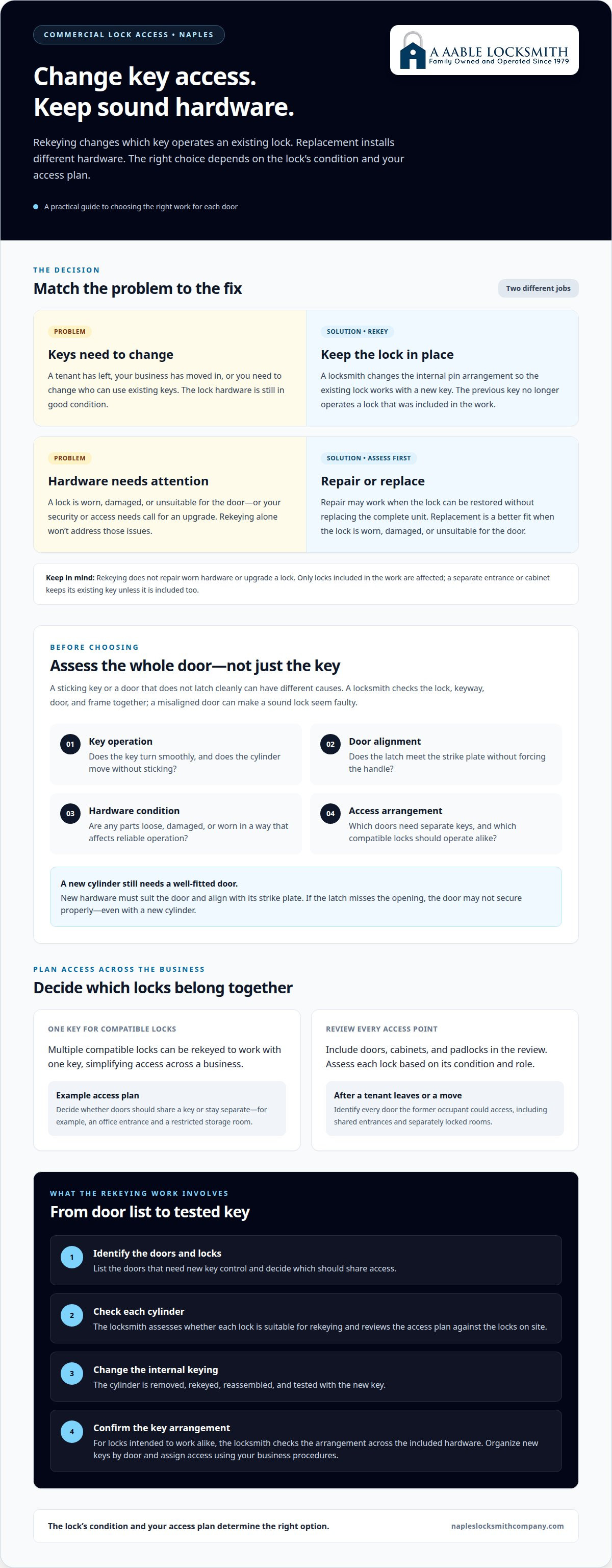
Rekeying changes the lock’s internal pin arrangement so it works with a new key. It suits sound hardware when the goal is to change key access. Replacement is a better fit when the lock is worn, damaged, or unsuitable for the door. For commercial lock rekeying in Naples, the hardware’s condition and the business’s access plan determine which option makes sense.
New hardware must suit the door and align with its strike plate. If the latch misses the opening, the door may not secure properly, even with a new cylinder. Older locks may also be less suited to current security or access needs, making an upgrade worth considering when the hardware’s condition or the business’s requirements have changed.
Before recommending work, a commercial locksmith can assess the following:
- Key operation: Check whether the key turns smoothly and the cylinder moves without sticking.
- Door alignment: Confirm that the latch meets the strike plate without forcing the handle.
- Hardware condition: Look for loose, damaged, or worn parts that could affect reliable operation.
- Access arrangement: Identify which doors need separate keys and whether compatible locks should operate alike.
Some high-security platforms support different key arrangements. For example, the Mul-T-Lock MTL™700 can be keyed differently, keyed alike, or master keyed. The MTL™700 uses 10 telescopic pin tumblers and two covered rotating magnets in each key. Its additional keys are cut only by authorized Mul-T-Lock dealers using the magnetic key card supplied with the lock. These details illustrate why a system’s key-control method matters alongside the hardware itself.
Repair is appropriate when the lock can be restored without replacing the complete unit. If the cylinder, latch, or another part is damaged, the right fix depends on which component has failed and whether the door is aligned. A Aable Locksmith is fully licensed and insured. The mechanical assessment still determines whether repair, rekeying, or replacement addresses the problem.
Maintenance can include tightening loose hardware, correcting alignment, and checking that the latch and key operate smoothly after work. For related details on commercial lock rekeying, consider how the door’s current condition and intended key access affect the choice.
Commercial lock rekeying and lock changes
Rekeying changes which key operates an existing lock, while replacement installs different hardware. In Naples, the choice depends on the lock’s condition, the access plan, and whether the hardware suits the door.
Rekeying Price Factors
The price depends on the case and is given after a quote request; key factors include the number of locks, their condition, and the work each cylinder needs. A locksmith also considers whether compatible locks can share one key or require separate key arrangements. These details help define the scope of commercial locksmith services without assuming every door needs the same work.
Available Rekeying Services
Commercial lock rekeying in Naples can change the keys for existing locks and set compatible locks to work with one key. The service is suited to locks that can be rekeyed and remain fit for use. A business can plan access by deciding which doors should share a key and which should stay separate, such as an office entrance and a restricted storage room.
Rekeying Risks and Limitations
Rekeying changes which key operates a lock, but it doesn’t repair worn hardware or upgrade the lock. A damaged cylinder, sticking latch, or misaligned door may still need repair or replacement. Only the locks included in the work are affected, so a separate entrance or cabinet lock keeps its existing key unless it is included too.
That distinction matters when a business needs more than new key control. Rekeying alone won’t address a lock in poor condition or provide a stronger lock. A locksmith can assess the hardware and explain whether rekeying, repair, or replacement suits the doors in question.
Rekeying Process and Business Preparation
The process starts by identifying the doors and locks and assessing whether each cylinder is suitable for rekeying. The locksmith removes the cylinder, changes its internal keying, reassembles it, and tests the new key. For locks intended to work alike, the locksmith also checks that the key arrangement works across the included hardware.
To prepare, identify the doors that need new key control and decide which should share access. The locksmith can review that plan against the locks on site. After rekeying, organize the new keys by door and assign access according to your business’s procedures. A clear door list helps prevent an entrance from being overlooked.
For a business weighing rekeying against a lock change, commercial lock rekeying is one way to review the service and its fit for existing hardware.
Rekeying after a tenant leaves
When a tenant leaves a commercial space, former occupants or others may still have keys. Rekeying changes the lock so the previous key no longer works, while the existing hardware stays in place. In Florida, start by identifying every door the departing tenant could access, including shared entrances and separately locked rooms.
Review the space door by door. A leased office, for example, may have an exterior entry, an interior office door, and a storage-room lock. Listing each opening helps define the work and reduces the chance of missing a less visible access point. Include shared doors, then distinguish them from areas used only by the departing tenant.
A locksmith can assess whether the locks are in suitable condition for rekeying. The decision depends on the hardware, not just the tenant’s departure. A worn cylinder, damaged keyway, or sticking latch may need repair or replacement rather than a key change alone. Sound locks can often be rekeyed to work with new keys.
Before work begins, set a key plan around the next occupant’s needs. Decide which doors should use the same key and which should stay separate. For instance, a business might use one key for its main entry and office, but a different key for a restricted records room. The locksmith can assess whether the existing locks support that plan.
- Identify access points: Include tenant-only doors, shared entrances, and separately locked rooms.
- Note lock condition: Flag a sticking key, loose hardware, or a latch that fails to align.
- Set key groupings: Specify which doors should share a key and which need separate access.
- Plan key handoff: Assign new keys to the people responsible for each area.
Rekeying changes the key that operates each serviced lock. It doesn’t change the physical lock or repair door damage. If the departing tenant used another entrance that isn’t included, that lock still works with its existing key. Review the entire leased space, not just the most visible front door.
After the work, the locksmith tests each rekeyed lock with its new key. The business can then distribute keys according to its access plan and clarify arrangements for shared entrances. If several tenants use common doors, include them in the plan to account for the departing tenant’s former access while preserving the access needed by remaining occupants.
Rekeying after moving into a property
A new commercial property may come with keys held by the previous owner, employees, contractors, or property managers. Rekeying changes which keys operate compatible existing locks, giving the incoming business a fresh starting point for access control. In Naples, map the doors your business will use rather than assuming the main entrance is the only lock to consider.
A locksmith can inspect the locks and compare their condition with your access plan. Include the main entrance, staff doors, offices, storage areas, and separately locked rooms. For example, a storefront with an office and stockroom may need separate key access for each space. The layout and existing hardware determine which locks can share a key.
Next, decide how staff access should work. Some businesses prefer one key for several compatible doors; others keep sensitive areas on separate keys. A master-key arrangement may suit a property with different access levels if the hardware supports it. Set the access structure before rekeying so the locksmith can assess the locks against a clear plan.
- Map entry points: Include employee entrances, interior offices, and storage doors.
- Group access: Decide which doors should operate with the same key.
- Separate restricted areas: Identify rooms that need a different key arrangement.
- Assess existing locks: Have the locksmith evaluate whether each lock is suitable for rekeying.
Rekeying doesn’t replace a worn lock or fix a door that fails to close properly. If an exterior lock sticks or its latch misses the strike plate, those problems need attention as part of the assessment. The locksmith can distinguish a key-control change from a hardware or alignment issue and explain how each affects the work.
Once the access plan is set, the locksmith rekeys the selected locks and tests each with its new key. Testing confirms that each intended key works on the included doors and that doors assigned separate access remain distinct. A written key-to-door record helps the business manage distribution, especially when rooms have different access arrangements.
For a business taking over a Naples property, rekeying can address uncertainty about existing keys without automatically replacing every lock. The decision depends on each lock’s condition and the access arrangement the business needs. Reviewing the doors, key groupings, and restricted areas gives the locksmith clear direction and helps establish a workable access-control plan.
Rekeying business door, cabinet, and padlocks
A business’s key plan often includes more than the main entrance. An office door, supply cabinet, and storage padlock may each secure different property. Rekeying can simplify key management, but each lock needs its own assessment. Its design and condition determine whether it can be rekeyed or needs another solution.
For a commercial door lock, a locksmith checks the cylinder and how the door operates. A sound cylinder may be rekeyed so an old key no longer works. If the lock is worn or damaged, changing the key won’t fix the problem. Commercial doors may also have different hardware and access needs from residential deadbolts.
Cabinet locks need their own review. A locked drawer holding keys, records, or supplies may serve a different purpose from an exterior door. Identify which cabinets need controlled access and whether each lock can be rekeyed. If a cabinet needs new hardware, the right replacement depends on its existing lock and how the cabinet is used.
Padlocks vary by design. Some can be rekeyed, while others have a fixed mechanism that needs a different solution. A locksmith can assess the lock instead of assuming a door-lock method applies. A storage-unit padlock and a cabinet cylinder, for example, can have different internal designs.
Before work begins, organize the locks by location and intended key access. A simple schedule can list the main door, office, cabinet, and padlock, then note which should share a key. If you’re considering a master-key arrangement, the locksmith must assess whether the existing locks support it. Don’t assume every lock can join one key system.
- Group by use: Separate exterior doors, staff areas, cabinets, and storage locks.
- Note the condition: Identify sticking keys, loose hardware, or locks that fail to operate smoothly.
- Set access levels: Decide which staff need access to each area.
- Test each lock: Confirm the new key works in every lock included in the rekeying work.
Testing each location matters. A key for the office shouldn’t operate a restricted cabinet unless that access is part of the plan. A clear lock schedule also distinguishes business hardware from residential locks elsewhere on the property, keeping the work focused on the right doors and storage areas.
A Aable Locksmith: Digital Keypad Lock Installation
A Aable Locksmith helps Naples businesses decide between rekeying existing locks and updating entry hardware. If a lock is in good condition but key access needs to change, rekeying may fit. For businesses considering keypad entry, A Aable Locksmith also installs digital keypad locks.
Not every opening uses a standard entry lock. A sliding glass door may need its own security solution, while damaged or unsuitable hardware may call for new hardware installation. Matching the work to each door keeps the plan focused on the actual issue.
Put Your Business’s Key Plan Into Practice
Turn your access needs into a clear plan for each entrance and work area. Decide who needs access, which doors should share a key, and where another entry method may suit the business. For commercial lock rekeying in Naples, A Aable Locksmith can assess existing locks, and digital keypad lock installation offers another option for suitable doors.
Some openings call for a different solution. A sliding glass door may need dedicated lock security, while a worn or unsuitable lock may be better served by new hardware installation. Matching the work to the door and its role keeps your next decision practical and focused.
A thoughtful key plan gives your business a practical foundation for managing access.
Frequently Asked Questions
Are You Licensed and Insured?
Yes. A Aable Locksmith is fully licensed and insured. These credentials provide useful context when arranging locksmith work for a commercial property. Keep the service scope clear by identifying the doors involved, the access arrangement you need, and any hardware concerns. These details connect the requested work with the property’s practical security needs.
How Long Will It Take For a Locksmith To Arrive?
Service appointments have an arrival window of approximately two hours, and customers are asked to be on site during that window. This is the arrival window, not the duration of rekeying or repair. Arrange for someone with access to the relevant doors to be present. If the work involves several areas, make them accessible for assessment.
Should I Replace or Rekey My Locks?
Choose rekeying when the existing lock is suitable and the main concern is who holds working keys. Replacement is more appropriate when a lock is damaged, worn, or no longer suits the business’s needs. A cracked lock housing, for example, presents a different problem from a sound lock after an employee leaves. The hardware’s condition and your access goal guide the choice.
How quickly can a locksmith rekey commercial locks in Naples?
The time required depends on the number and condition of the locks, their cylinder designs, and the requested access arrangement. One compatible lock involves a different scope from several doors with separate key groups. Arrival time is separate from the work itself. Identifying the doors and intended key groups helps define the job before work begins.
Can commercial locks be rekeyed without replacing the hardware?
Yes. A compatible lock can be rekeyed without replacing its hardware. The locksmith changes the lock’s internal configuration so a new key operates it. This doesn’t fix physical damage or change the lock’s design. If the lock body is broken or the door hardware is failing, rekeying alone won’t resolve the mechanical problem.
When should a business rekey locks instead of replacing them?
Rekey when the lock works properly but the business needs to change key access, such as after a staff change or lost key. Consider replacement when the hardware is damaged or no longer suits the door’s use. A business may also choose new hardware for a different locking arrangement, rather than simply changing which keys operate the existing lock.
What types of commercial locks and master key systems can be rekeyed?
Rekeying applies to existing locks whose cylinder design supports a key change. A master-key arrangement can provide different access levels across compatible locks, such as one key for an office and another that operates several assigned doors. The hardware determines which arrangement works. A locksmith assesses the lock types and requested access plan before setting up a system.
Are Naples commercial locksmiths licensed, insured, and background-checked?
Background screening is separate, and licensing or insurance alone doesn’t establish whether an individual has undergone it. For a commercial property, keep a record of the work performed and keys issued. This helps your business track access after service without confusing screening credentials with lock or key control.


