


Article by
Jonathan Dier
Jonathan Dier is the owner of A Aable Locksmith, a family owned and operated Locksmith company serving the Naples Florida area since 1979. He has over 35 years experience in the Locksmith and Security industry. A Aable Locksmith specializes in residential and commercial security, focusing on customer satisfaction.
The most expensive security decision isn't always the one with the larger upfront invoice; sometimes it's spending money to service a lock that salt air and humidity have already compromised from the inside out. If you've just moved into a new property or need to revoke access from former contractors, you're likely wondering which is more expensive: rekeying your existing cylinders or replacing your exterior door hardware entirely. It's completely reasonable to want total peace of mind without discarding functional, high-end handlesets that still have years of dependable service left in them.
In this guide, you'll discover whether rekeying or full hardware replacement costs more and how to make the smartest security investment for your home. We'll walk through a practical decision framework to help you spot when physical replacement is genuinely necessary, clear up common confusion around service call costs, and review durable hardware options built to withstand coastal Florida weather.
Key Takeaways
- Learn which is more expensive and why full hardware replacement carries significantly higher upfront costs than resetting internal cylinder pins on functional locks.
- Discover why environmental damage, such as Gulf Coast salt air corrosion or internal mechanical wear, can make complete replacement the wiser long-term choice.
- See how lock brand construction, high-security cylinders, and the overall quantity of exterior doors impact your service needs.
- Explore how upgrading to digital keypad deadbolts can save money over time by eliminating repetitive rekeying for rental properties.
- Follow a practical four-step inspection process to assess your existing hardware's physical condition before deciding on a solution.
Which Is More Expensive: Rekeying or Replacing Locks?
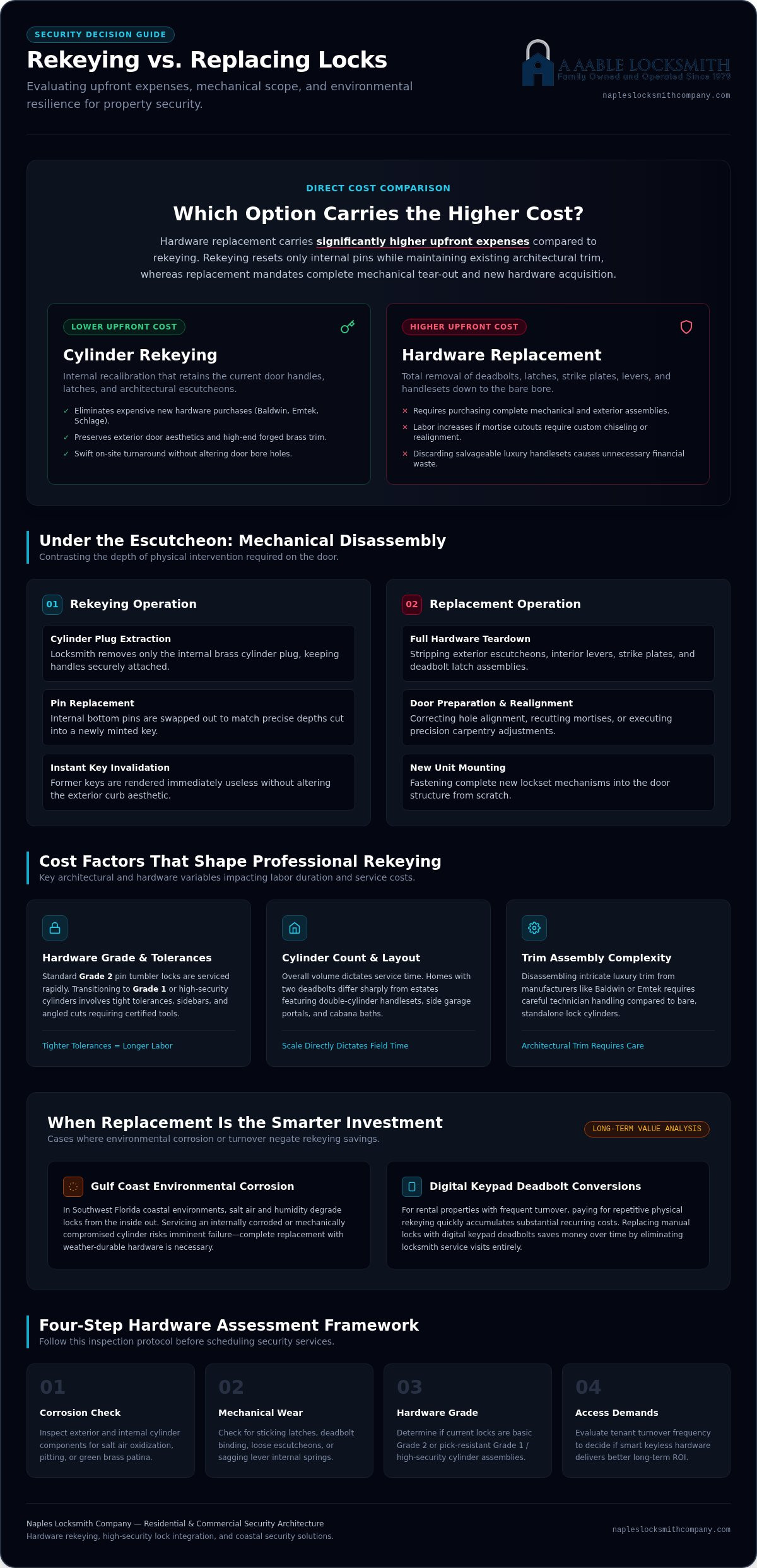
When homeowners evaluate door security, the verdict is straightforward: replacing your lock hardware is consistently more expensive than rekeying it. Rekeying targets only the internal brass cylinder, leaving the exterior escutcheon plates, latch bolts, and decorative handles completely intact. Full replacement, on the other hand, demands the purchase of entirely new mechanical assemblies alongside additional labor to fit and align the new hardware to the door.
To see how these two methods compare in practice, watch this breakdown from an experienced technician:
For doors fitted with high-end architectural trim, preserving your existing fixtures prevents unnecessary waste. Deciding which is more expensive often hinges on whether your existing setup can be recalibrated or must be scrapped.
The Mechanics of Rekeying vs. Full Hardware Replacement
During a rekeying service, professional locksmiths remove the lock cylinder plug and replace the tiny internal bottom pins. These new pins correspond to the distinct depths cut into a freshly minted operating key, rendering any old keys completely useless. The external trim never leaves the door for long, and the lock's aesthetic profile remains unchanged. Replacement requires stripping the door down to its bare bore hole, pulling out deadbolt latches, strike plates, and interior levers before installing brand-new components.
Comparing Upfront Material and Labor Expenses
The core price disparity stems directly from materials. Premium forged brass hardware from makers like Baldwin, Emtek, or Schlage represents a significant manufacturing investment. Buying new units for multiple entry points quickly escalates project expenses. Labor also increases when new locksets do not align cleanly with older mortises or pre-drilled holes, requiring custom chiseling and precision woodwork.
Choosing professional lock rekeying bypasses new hardware costs entirely while delivering swift turnaround times. If your current cylinders are outdated or vulnerable to picking and bumping, you can also consider upgrading to modern high-security locks to reinforce your perimeter without discarding your overall entryway design.
Cost Factors That Influence Professional Lock Rekeying
While rekeying is routinely the more budget-conscious alternative to full replacement, the exact scope of work depends on your property's physical setup. When evaluating which is more expensive across different service scopes, the overall investment is shaped by hardware architecture, lock condition, and how your access system is organized.
Every home presents unique hardware challenges, especially across multi-door residences or properties requiring custom master key tiering for guest casitas and service staff. Industry cost surveys compiled across professional locksmith networks consistently show that labor duration expands whenever technicians must carefully disassemble complex trim assemblies rather than straightforward standalone cylinders.
Cylinder Complexity and Hardware Grade
Standard Grade 2 residential deadbolts use basic pin tumbler designs that technicians can rekey quickly right from a mobile service bench. However, transitioning to pick-resistant Grade 1 assemblies or patented high-security lock systems introduces tighter mechanical tolerances. These specialized cylinders incorporate sidebars, angled cuts, or restricted key blanks that require certified factory tools to repin properly.
Number of Entry Points and Door Configurations
The total cylinder count on your exterior doors directly dictates on-site labor time. A home with two deadbolts requires less field labor than an expansive estate with double-cylinder handlesets, side garage portals, and cabana baths. Homeowners often ask which is more expensive: rekeying multiple entryways across several distinct manufacturer keyways or standardizing the whole house onto a single key system.
Aligning every perimeter door under one operational key simplifies daily access, though practical variables influence the service call:
- Keyway Compatibility: If your front door uses Schlage cylinders while the back patio relies on Kwikset, those locks cannot share a physical key without replacing internal plugs or cylinder housings.
- Hardware Corrosion: Screws seized by years of coastal humidity require gentle extraction techniques to avoid damaging delicate exterior door finishes.
- Integrated Multi-Point Hardware: Heavy terrace doors often hide locking mechanisms within mortised channels, requiring extra precision during disassembly.
If you're unsure whether your existing deadbolts can be synchronized or preserved, scheduling a thorough assessment with a trusted local locksmith can help pinpoint the most efficient path forward for your home.
When Lock Replacement Costs More and When It's Necessary
Lock replacement carries a higher initial price tag than rekeying, but there are clear moments when continuing to service failing parts turns into wasted effort. Mechanical wear eventually degrades any lock assembly. Internal cams strip down over thousands of turns, cast zinc bolt housings crack under stress, and spring latches suffer metal fatigue until they stick in the door jamb. Rekeying an internally broken lock doesn't fix its underlying structural flaws, leaving your home vulnerable to sudden lockouts.
Replacing hardware also becomes vital when older deadbolts lack modern structural defenses. Obsolete locks often feature hollow strike plates, short mounting screws, and brass pins that lack hardened steel anti-drill inserts. Evaluating which is more expensive requires looking past the immediate service call to the safety risks of keeping compromised components on your exterior entry points.
Southwest Florida Climate and Salt Air Degradation
Living along the Gulf Coast exposes exterior hardware to relentless airborne salt and heavy ambient moisture. These conditions trigger galvanic corrosion, causing internal zinc cylinders to oxidize and seize tight. When salt crusting binds the internal plug, technicians cannot safely dismantle the housing without damaging the lock. Field reports published across coastal building and home hardware studies confirm that untreated builder-grade metals fail rapidly in marine environments. Installing marine-grade assemblies protected by Physical Vapor Deposition (PVD) finishes shields the brass from coastal pitting and ensures long-term operation.
Upgrading from Traditional Keys to Keyless Convenience
Switching from mechanical keyed locks to modern digital keypad locks requires a larger upfront hardware investment, but it delivers unmatched daily flexibility. Electronic systems remove physical keys from circulation entirely, allowing you to grant, monitor, and revoke access codes instantly via backlit touchscreens.
Homeowners frequently wonder which is more expensive over time: paying for periodic service visits every time access needs change, or making an upfront upgrade to electronic convenience. For private residences and vacation rentals alike, keyless entry removes the vulnerability of lost mechanical keys. If you want to pair this digital functionality with striking architectural curb appeal, explore premium options designed for coastal entries to protect both your property's value and its perimeter security.
Total Cost of Ownership: Analyzing Long-Term Hardware Value
Focusing entirely on the initial bill obscures the true cost of residential security. When calculating which is more expensive over a three-to-five-year timeline, the question shifts from simple part costs to operational durability. Cheap builder-grade hardware made from die-cast zinc or pot metal wears down quickly under daily torque, requiring frequent repairs. Investing in commercial-grade, solid forged brass fixtures provides decades of internal mechanical reliability, dramatically lowering the need for future changeouts.
Warranty terms also reflect this divide. Mass-market retail deadbolts typically carry short limited warranties that rarely cover finish deterioration from salt exposure or internal spring decay. Factory-authorized residential hardware from manufacturers like Yale, Schlage, and Emtek backs heavy-duty mechanisms with extensive mechanical protection, safeguarding your investment long after installation.
Rental Properties and Frequent Occupancy Turnover
Managing high-turnover real estate completely changes the financial math. For seasonal rental homes in Marco Island or downtown Naples, scheduling a technician between departing tenants creates recurring logistical friction. Property managers quickly discover which is more expensive: arranging repeated cylinder service calls year after year, or installing a programmable keyless deadbolt once.
Electronic keypad locks allow owners to issue unique numerical codes for arriving guests, cleaning crews, or maintenance contractors. When a tenant checks out, that specific access code can be deleted immediately from an administrative keypad or management app. You eliminate the administrative headache of lost keys, prevent unauthorized duplicates, and bypass repetitive service fees entirely.
The Hidden Risks and Costs of DIY Lock Installations
Attempting a DIY lock replacement often creates unexpected expenses that far exceed the initial savings. Modifying a door without professional carpentry jigs frequently leads to costly structural damage:
- Damaged Door Stiles: Slipping hole saws or crooked pilot holes can permanently split premium mahogany, fiberglass, or solid core entry doors.
- Deadbolt Binding: If latch mortises and frame strikes are misaligned by even a fraction of an inch, the bolt encounters constant friction. In motorized electronic deadbolts, this lateral resistance burns out drive motors prematurely.
- Frame Vulnerabilities: Factory-supplied short screws fail to bridge the structural gap into the wall framing, allowing strike plates to tear away during forced entry attempts.
Explore keypad deadbolt installation options for your home
Making the Right Choice for Your Southwest Florida Property
Determining whether to service your existing hardware or install new locksets doesn't have to be complicated. When weighing which is more expensive for your budget, a straightforward assessment of your entryway will help you make a confident, lasting choice. Follow this four-step evaluation framework:
- Inspect Mechanical Smoothness and Exterior Finish: Insert your key and turn it slowly. If the cylinder turns smoothly without binding and the protective finish remains intact, rekeying preserves your investment. If the key sticks or the exterior housing shows heavy pitting, internal metal fatigue has begun.
- Define Your Core Objective: Determine whether you simply need to revoke access from prior occupants or contractors, or if you want to alter the architectural style of your entryway. Rekeying resolves access control; styling updates require new hardware.
- Check Hardware Compatibility: If you want to install keyless hardware, verify whether your entry utilizes standard cylindrical boreholes or multi-point locking mechanisms that require specialized electronic integration.
- Consult a Local Security Specialist: An experienced eye can quickly verify whether existing deadbolts meet modern forced-entry standards or require complete replacement.
Working with Impact Doors and Coastal Architectural Requirements
Properties in Collier and Lee counties must meet rigorous Florida Building Code guidelines for windborne debris and hurricane resistance. Modifying mortise pockets or cutting new holes into certified impact doors can void manufacturer warranties and weaken door slab integrity. High-performance fiberglass and impact mahogany doors require precision carpentry fitting so that bolts seat cleanly without friction.
Entry defense extends beyond the front door. Lanais and patio sliders represent common entry targets along the coast. Pairing serviced front deadbolts with reinforced sliding glass door lock security ensures your entire home envelope remains thoroughly defended against intrusion and stormy weather.
The Value of a Trusted Local Family Locksmith
Resolving which is more expensive for your particular property comes down to honest guidance. Serving homeowners throughout Naples, Marco Island, and Bonita Springs since 1979, A Aable Locksmith brings over 45 years of continuous local craftsmanship to every door. Rather than pushing costly, unnecessary full hardware changeouts, our mobile technicians arrive prepared to preserve quality forged assemblies whenever possible, providing dependable security solutions built to thrive in coastal Florida.
Securing Your Southwest Florida Home with Confidence
Deciding which is more expensive ultimately comes down to balancing upfront expenses against the physical condition of your doors. Preserving high-quality decorative handlesets through cylinder rekeying keeps your project budget intact while completely resetting access privileges. However, when internal springs fail or coastal salt air corrodes the metal, investing in durable replacement hardware protects your perimeter for decades.
Family-owned and operated in Naples and Collier County since 1979, A Aable Locksmith brings over 45 years of specialized residential and commercial door security experience to every project. Our fully equipped mobile service fleet arrives directly at your home, ready for precision rekeying, electronic deadbolt integration, and custom fitting on impact-rated entries.
Taking the right steps now ensures your entry doors stay beautiful, mechanically sound, and ready to protect what matters most.
Frequently Asked Questions
Is it cheaper to rekey locks or buy new ones?
Rekeying is significantly cheaper than buying brand-new locksets. When asking which is more expensive, purchasing complete replacement hardware always demands a higher budget because you're paying for brand-new handles, latches, and decorative trim. Rekeying simply alters the internal pin tumblers inside your existing cylinder, allowing you to establish total key control without paying for unnecessary manufacturing materials or complex carpentry labor.
Can all types of door locks be rekeyed?
Most traditional residential and commercial cylinder locks can be rekeyed, provided the internal mechanism remains structurally intact. Quality pin-tumbler systems from brands like Schlage, Yale, and Emtek are designed specifically for servicing. However, cheap builder-grade locks with sealed or crimped housings cannot always be disassembled. If heavy coastal corrosion has seized the plug completely, replacement becomes the only safe, reliable solution for your entryway.
How long does a professional lock rekeying service typically take?
A professional locksmith typically rekeys a standard exterior lock cylinder in about ten to fifteen minutes once on site. For an average Southwest Florida home with three or four exterior doors, a complete rekeying service usually wraps up within an hour. The total duration can vary slightly if the technician encounters seized exterior mounting screws, intricate decorative mortise hardware, or multi-point patio mechanisms that require careful alignment.
Will rekeying my locks make them more secure against intruders?
Rekeying restores access security by ensuring that former homeowners, contractors, or tenants can no longer unlock your door. However, it doesn't alter the physical strength of the lock itself. If your current deadbolt uses thin strike plates or lacks anti-drill steel pins, rekeying won't stop forced entry attempts. Upgrading to high-security Grade 1 cylinders or reinforced deadbolts is recommended if structural resistance is your top priority.
Why do smart keypad locks cost more to install than mechanical locks?
Smart keypad deadbolts require specialized installation because they integrate motorized latch drives, touchscreens, and electronic circuit boards that demand absolute mechanical alignment. When evaluating which is more expensive, digital hardware carries higher upfront material costs and requires precise door prep so the bolt throws without resistance. Any minor latch friction causes the motor to bind, draining batteries rapidly and causing premature motor failure.
Can I rekey all the doors in my house to use the exact same key?
Yes, you can key all exterior doors to a single physical key, provided the locks share the same internal brand keyway. For instance, multiple locks manufactured by Schlage or Emtek can easily run off one operational key. If your property currently mixes competing keyways like Kwikset and Yale, a locksmith can often swap out individual cylinders to match them without forcing you to replace the decorative handlesets.
What happens if my existing door hardware is too damaged to rekey?
If internal cams are stripped or salt air has heavily corroded the lock cylinder, a professional technician will recommend a complete hardware replacement. Servicing broken internal components only leads to frustrating lockouts later on. A specialist will carefully remove the degraded assembly, prep the door mortise to preserve your door slab's structural integrity, and install a brand-new marine-grade deadbolt designed to withstand humid Gulf Coast conditions.


