


Article by
Jonathan Dier
Jonathan Dier is the owner of A Aable Locksmith, a family owned and operated Locksmith company serving the Naples Florida area since 1979. He has over 35 years experience in the Locksmith and Security industry. A Aable Locksmith specializes in residential and commercial security, focusing on customer satisfaction.
What if restoring complete control over your home's security didn't require tossing out that beautiful, high-end front door handleset? If you've recently purchased a property, finished a renovation, or realized that seasonal guests and service contractors might still hold unaccounted duplicate keys, that lingering uncertainty is completely natural. Knowing when to rekey your locks gives you the power to reset your access perimeter immediately, securing your home without throwing away durable, attractive hardware that still functions flawlessly.
You shouldn't have to replace solid architectural locks just to regain genuine peace of mind. In this guide, you'll discover the exact scenarios when rekeying your existing locks protects your home faster and more affordably than full hardware replacement. We'll walk you through how professional cylinder repinning works, how to consolidate multiple exterior doors under one convenient key, and the telltale mechanical warning signs that indicate when an outright hardware upgrade is truly necessary.
Key Takeaways
- Understand the precise mechanical distinction between repinning an existing cylinder and replacing an entire exterior handleset.
- Identify the critical life events and seasonal transitions that dictate exactly when to rekey your locks for immediate access control.
- Evaluate your existing door hardware to determine whether a straightforward rekey or a complete mechanical upgrade makes the most sense.
- Discover why Southwest Florida's humid, coastal environment demands specialized care and professional inspection during the rekeying process.
- Learn how master keying and professional cylinder pinning streamline key management across all entry points without sacrificing physical security.
What Does It Mean to Rekey Your Locks?
Rekeying is the process of altering the internal components of an existing lock cylinder so that old keys no longer operate it. Rather than removing the entire exterior assembly from the door, a locksmith leaves the visible handleset, latch bolt, and decorative escutcheon in place. By accessing just the core cylinder, the technician replaces the internal pins to match an entirely different, newly cut key.
This approach solves one of the most common dilemmas for property owners: how to revoke unauthorized access without discarding expensive, high-end hardware. Whether you want to preserve handcrafted brass handlesets or simply eliminate a drawer full of mismatched keys, rekeying allows you to consolidate multiple entrance doors so they all turn smoothly with a single key. Understanding exactly how this mechanical adjustment works helps clarify when to rekey your locks versus opting for complete replacement.
To better understand the economic and practical balance between these two approaches, watch this helpful comparison:
The Mechanics of Pin Tumbler Rekeying
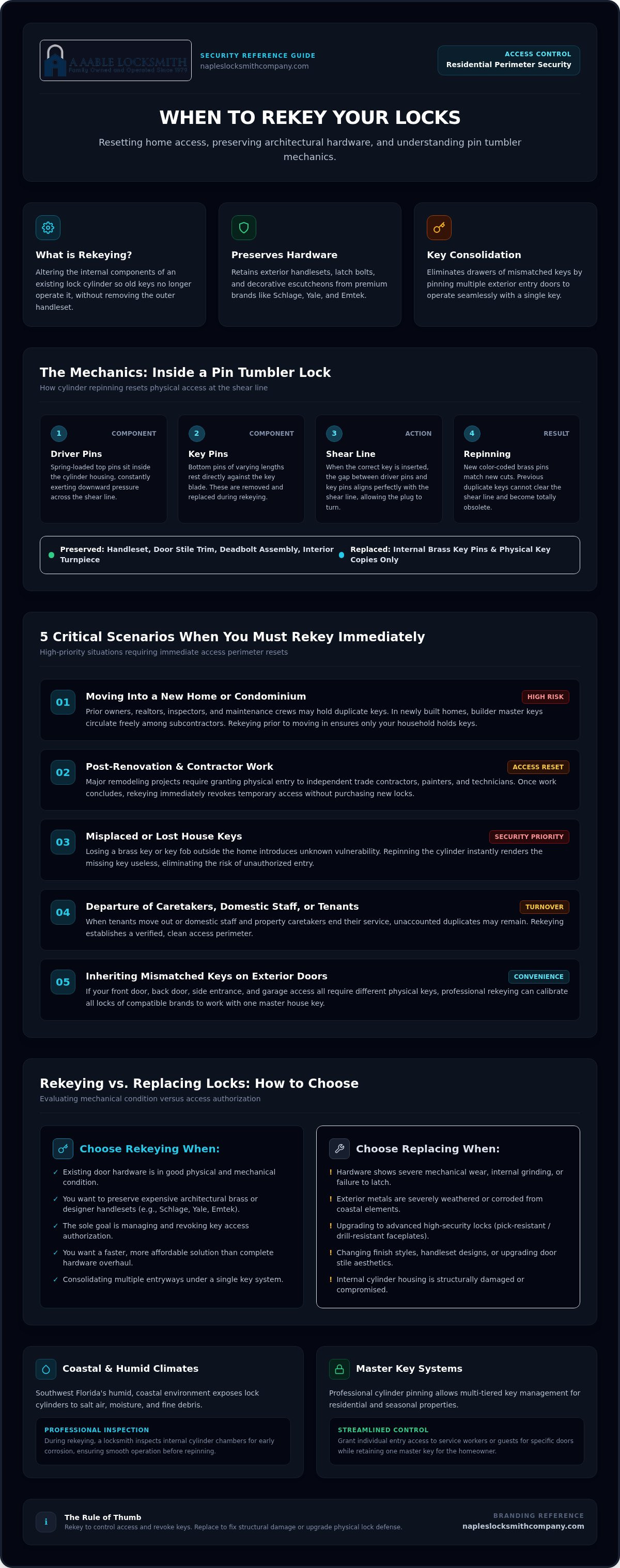
Most exterior residential doors rely on a traditional pin tumbler lock mechanism. Inside the cylinder plug, a series of spring-loaded driver pins sit atop corresponding key pins of varying lengths. When the correct key slides in, its precise cuts raise each pin pair so the boundary between them aligns perfectly with the cylinder's shear line. A locksmith removes the cylinder, extracts the old key pins, and drops in a new series of color-coded brass pins calibrated to match brand-new cuts. Once reassembled, former keys cannot clear the shear line, rendering previous duplicates entirely obsolete.
Rekeying vs. Replacing: Clearing Up the Confusion
Replacing a lock means unscrewing the housing, extracting the bolt, and mounting brand-new hardware to your door stile. Rekeying keeps your original handleset, deadbolt trim, and interior turnpiece intact while updating key authorization from the inside out. When evaluating whether to replace or rekey your locks, remember that replacement serves to fix mechanical wear, weathered metals, or security vulnerabilities, while rekeying manages key access.
If you have premium hardware from manufacturers like Schlage, Yale, or Emtek, repinning retains that architectural craftsmanship at a fraction of the effort. If your goal includes upgrading older entry points with pick-resistant cylinders or drill-resistant faceplates, installing advanced high-security locks provides structural defenses that simple repinning cannot match.
Top Scenarios When You Must Rekey Your Locks Immediately
Lock hardware can last for decades, but access authorization changes constantly. Property owners often struggle to pin down the exact threshold between keeping their current hardware setup and requesting professional service. Knowing when to rekey your locks comes down to evaluating who has handled physical copies of your entry keys throughout the lifespan of the home.
Consider rekeying an immediate security priority in these situations:
- Moving into a previously occupied house, condominium, or newly built residence.
- Concluding extensive renovations involving independent trade contractors.
- Misplacing a key fob or brass house key outside the home.
- Managing departures of domestic assistants, property caretakers, or tenants.
- Inheriting a frustrating collection of different keys for every exterior entry door.
Moving into a New Home or Condo
Taking ownership of a property means taking on its unrecorded history. Between previous owners, real estate agents, home inspectors, and maintenance crews, dozens of individuals may possess functioning duplicates. Even new construction presents risks, as builder master keys frequently circulate freely among subcontractors. Scheduling professional lock rekeying prior to unloading your furnishings guarantees a clean slate, ensuring only your household holds authorized keys.
Post-Renovation and Service Contractor Access
Major remodeling projects require granting access to painters, tile setters, electricians, and general contractors over several weeks or months. While reputable firms manage their staff responsibly, it's virtually impossible to track whether temporary keys were duplicated off-site for convenience. Repinning your cylinders right after the final punch list terminates third-party access permanently, preserving your design investments while locking down your perimeter.
Lost Keys, Tenant Departures, and Domestic Changes
A missing key is an open vulnerability. Whether a set was dropped along a public sidewalk or left behind during travel, replacing internal tumblers eliminates the threat of someone tracing that key back to your address. Similarly, turning over a long-term rental property demands a pin reset to protect incoming residents from former tenants. Family separations and changes in cleaning staff or house-sitting personnel require the same proactive approach.
If you're managing any of these transitions or want to simplify your key ring so one key operates both the front door and the side garage entry, consult a trusted local specialist at A Aable Locksmith to assess your current door security and restore complete control over your home.
Rekeying vs. Replacing Locks: How to Choose the Right Path
Deciding between modifying your existing cylinder or tearing out the entire lock comes down to three factors: the structural integrity of the hardware, its architectural value, and your overall security goals. Homeowners often assume any breach in key control warrants a trip to the hardware store for complete replacements. That assumption wastes sound materials and inflates project budgets unnecessarily. Determining when to rekey your locks versus when to replace them requires a careful assessment of mechanical performance and physical wear.
When Rekeying Is Your Best Decision
Rekeying is the most sustainable, budget-conscious choice whenever the lock's external and internal mechanics operate without flaw. If your doors feature solid brass or sand-cast bronze handlesets from makers like Baldwin or Emtek, repinning preserves that custom craftsmanship. It allows you to align multiple entry points under a single key blank while resetting your access perimeter in minutes, completely bypassing the expense of brand-new exterior hardware.
When Full Lock Replacement Is Unavoidable
Hardware replacement becomes mandatory when the internal mechanism suffers from mechanical fatigue or structural vulnerability. Coastal humidity and persistent salt air can pit internal springs, seize tailpieces, and cause heavy latch binding that no amount of lubricant will resolve. If a lock cylinder exhibits excessive play, catches intermittently, or has suffered physical tampering, repinning the tumblers will not fix the underlying mechanical damage.
To help simplify this choice, compare how your current setup aligns with the core requirements of each approach:
- Aesthetic Preservation: Choose rekeying if you love your designer door trim, matching finishes, and customized architectural styling.
- Mechanical Wear: Choose replacement if deadbolts stick, latches fail to extend fully into the strike plate, or screws are stripped.
- Grade Standards: Choose replacement if you want to swap builder-grade residential deadbolts for rugged ANSI Grade 1 deadbolts.
- Security Defenses: Choose replacement when upgrading an vulnerable entrance to specialized high-security locks featuring hardened steel inserts, drill barriers, and patented key blanks.
Understanding these practical boundaries ensures you never spend money discarding well-engineered deadbolts that simply need fresh pins. If you decide that an older cylinder lacks modern pick or bump resistance, review our comprehensive guide on Schlage high security locks to discover how reinforced cylinders deliver heavy-duty forced-entry protection across vulnerable entryways.
Special Considerations for Coastal and Seasonal Homeowners
Living along the Gulf Coast introduces unique security and hardware challenges that generic guides rarely address. Between Collier County's massive seasonal population surge and the relentless exposure to humid, salt-heavy breezes, Southwest Florida properties require a specialized maintenance approach. Recognizing when to rekey your locks in this region involves tracking both service access schedules and the physical tolls of coastal weather.
Managing Keys for Seasonal Absence and Property Watch
Each fall, thousands of winter residents return to Collier County, and each spring, properties are entrusted to extended care networks. House watchers, pool technicians, pest control operators, and landscapers all end up with physical door keys over months of vacancy. Rekeying right before your return in the fall, or establishing a restricted master key system, gives you total certainty over access. A master system permits service staff to enter the utility room or lanai without unlocking private living quarters.
Corrosion, Salt Air, and Coastal Lock Degradation
Airborne sea salt and extreme humidity accelerate oxidation inside lock cylinders. Tiny steel tumbler springs and brass cylinder plugs can corrode silently, making key insertion rough and stiff. When a professional technician repins your cylinders, they also service these inner components, removing airborne contaminants and applying dry Teflon or graphite lubricants. Standard oil-based sprays like common WD-40 should never be sprayed into lock cylinders; they create a sticky residue that traps dust, sand, and moisture, quickly seizing internal pins.
Securing Vulnerable Patio and Lanai Openings
Front entrances receive most of the attention, yet rear access often presents the weakest link in coastal floorplans. Large multi-panel sliding doors opening to lanais or pool decks feature lightweight factory latches that bend under pressure or fail from track corrosion. Reinforcing these openings with specialized sliding glass door locks creates an unbroken security perimeter alongside your freshly rekeyed entry deadbolts, preventing intruders from simply lifting heavy sliding panels off their tracks.
Timing your access updates with the seasonal migration keeps your property secure throughout extended absences. If you're coordinating care for a seasonal residence or updating your locks after an extended vacancy, knowing when to rekey your locks protects both your property value and your peace of mind.
Why Work with a Professional Locksmith for Rekeying?
Online tutorials make rekeying look like a five-minute weekend hobby. In reality, modern architectural cylinders require exacting tolerances measured down to thousandths of an inch. While understanding when to rekey your locks is a straightforward decision, executing the mechanical repinning correctly demands specialized tools, calibrated factory pins, and trade experience.
The Hidden Risks of DIY Hardware Rekey Kits
Inexpensive DIY kits purchased on the web frequently turn a minor maintenance task into an expensive emergency. The moment you remove a cylinder's retaining clip without the exact plug follower diameter, upper driver pins and delicate phosphor bronze springs fly out across the floor. Choosing a replacement bottom pin off by just one size increment can cause severe binding, lock a key permanently inside the keyway, or allow unauthorized keys with near-depths to bypass the shear line entirely.
Comprehensive Security Assessment During Rekey Service
A professional locksmith does far more than drop fresh brass pins into a plug. While servicing your entry points, a skilled technician conducts a thorough check of the entire opening:
- Verifying that heavy jamb strike plates are anchored securely with three-inch screws driven straight into structural wall studs, preventing kick-ins.
- Inspecting latch bolt throw to confirm deadbolts fully extend into the frame cavity to activate their deadlocking mechanisms.
- Checking door alignment and seasonal thermal warping, ensuring bolts slide effortlessly without dragging against jamb strikes.
For custom architectural entries, precision alignment ensures high-end finishes stay protected. You can explore how professional fitting preserves custom entries in our detailed guide on high-end front door locks in Naples.
Restoring Your Home Security with Local Family Craftsmen
Security rests on accountability. Family-owned and operated across Southwest Florida since 1979, A Aable Locksmith brings three generations of hands-on mechanical craft to every job site. Rather than offering hurried fixes, fully outfitted mobile service workshops arrive directly at your property, stocked with original factory pin specifications for Schlage, Yale, Emtek, and Baldwin hardware.
Knowing when to rekey your locks gives you complete control over who enters your sanctuary. Partnering with a dedicated neighborhood craftsman ensures every cylinder turns smoothly, every latch throws cleanly, and your home remains genuinely secure.
Secure Your Naples Home with Confidence
Deciding when to rekey your locks shouldn't mean sacrificing the architectural elegance of your entryways. Whether you're settling into a new property, wrapping up seasonal remodeling, or managing access for local service staff, repinning existing cylinders delivers an immediate, dependable security reset. You keep your high-end hardware intact while instantly revoking old access permissions across every exterior door.
Since 1979, A Aable Locksmith has protected homeowners throughout Southwest Florida with dedicated craftsmanship and neighborly care. As a third-generation, family-owned team, our mobile workshops bring decades of mechanical expertise directly to your door, servicing premium hardware from Schlage, Yale, Baldwin, and Emtek with exact factory pin tolerances.
True peace of mind starts with knowing exactly who holds the keys to your front door. Take control of your perimeter, protect your family, and enjoy the lasting security your home deserves.
Frequently Asked Questions
Can all exterior door locks be rekeyed to use the same single key?
Yes, provided the lock cylinders share the same internal keyway manufacturer profile. Locks produced by the same brand, such as Schlage or Yale, use matching keyway grooves and pin spacing. If your front door has an Emtek handleset and your side door has a Schlage deadbolt, they can usually be keyed alike. Mixing incompatible keyways requires replacing select cylinders so one key profile fits every lock.
How long does a professional locksmith take to rekey standard residential locks?
A professional locksmith typically rekeys an exterior cylinder in roughly 10 to 15 minutes per lock. For a typical home in Naples with three or four exterior entry points, the entire service usually takes under an hour. Because mobile service trucks carry dedicated keying kits and pre-gauged pins, on-site repinning is efficient. Technicians also test cylinder rotation and strike alignment before handing over your new keys.
Is it significantly cheaper to rekey my house locks rather than replacing them?
Yes, rekeying is substantially more cost-effective than purchasing brand-new architectural locksets. When deciding when to rekey your locks, remember that repinning reuses your existing solid brass housing, handles, and deadbolt mechanisms. You avoid purchasing expensive new hardware packages while achieving identical access control. Rekeying only requires labor and precision brass tumblers, making it the most sensible financial path for structurally sound entry doors.
Can I rekey a lock if I have completely lost the original operating key?
Yes, a professional locksmith can rekey a cylinder even if no functioning key exists. While having the original key allows a technician to turn the plug quickly for disassembly, skilled locksmiths can pick the cylinder into the unlocked position or use specialized decoding tools. Once the cylinder plug turns, it slides out smoothly so the old internal pins can be removed and replaced with new cuts.
What is the main difference between master keying and standard lock rekeying?
Standard rekeying configures a lock to open with only one specific key cut, while master keying creates a multi-tiered hierarchy. In a master key system, cylinders contain specialized split pins that establish two different shear lines. This internal structure allows a single master key to open every door on the property, while individual change keys operate only designated entrances, such as guest suites or detached garages.
Will rekeying my locks fix a deadbolt that is sticking or difficult to turn?
No, rekeying alters key clearance at the shear line but does not solve underlying physical alignment or mechanical latch flaws. In coastal environments like Southwest Florida, stiff turning usually stems from frame shifting, settling foundations, salt air corrosion, or misaligned jamb strikes. If a bolt drags against the strike plate, a locksmith must adjust door alignment, clean corrosion, or perform mechanical lock repairs.
How often should homeowners proactively rekey their exterior door locks?
Most homeowners should rekey every few years or immediately following major household, service, or tenancy transitions. Knowing when to rekey your locks is particularly vital for seasonal residents in communities like Naples and Marco Island. If you rely on recurring house watchers, maintenance technicians, or seasonal rental turnovers, scheduling regular rekeying maintains a strict chain of custody, ensuring that no forgotten duplicates remain in circulation.


