
Article by
Jonathan Dier
Jonathan Dier is the owner of A Aable Locksmith, a family owned and operated Locksmith company serving the Naples Florida area since 1979. He has over 35 years experience in the Locksmith and Security industry. A Aable Locksmith specializes in residential and commercial security, focusing on customer satisfaction.
What if the very doors meant to protect your Naples business are actually its biggest liability? It's a question many local owners face when a high-traffic entrance stops latching correctly or the humid salt air begins to corrode a standard lockset. You might worry about an upcoming fire marshal inspection or wonder if your entryways truly meet the 2010 ADA Standards. We understand these frustrations because we've helped neighbors throughout Southwest Florida solve them for years. It's not just about a lock; it's about the peace of mind that comes from knowing your property is secure and your customers are safe.
In this guide, you'll discover why a commercial door hardware specialist is essential for maintaining the backbone of your business security and life-safety compliance. We'll explain how to navigate the 9th Edition of the Florida Building Code before it takes effect on December 31, 2026, and why Grade 1 hardware is the only real choice for long-term durability. From managing updated wind load requirements to ensuring smooth operation for every guest, you'll learn how the right technical solutions create a more professional and protected environment for your staff and clientele.
Key Takeaways
- Learn how a commercial door hardware specialist bridges the gap between general construction and technical security to protect your facility.
- Discover why commercial-grade hardware is built for millions of cycles and why "cheap" residential alternatives often fail in business settings.
- Understand the "Life-Safety" mandate and ADA requirements that keep your business compliant with accessibility and emergency egress codes.
- Identify the specific finishes, such as 316-grade stainless steel, required to prevent corrosion from the harsh Naples salt air and humidity.
- Explore the benefits of working with a local, multi-generational partner who understands the specific security needs of Southwest Florida retail and hospitality.
What is a Commercial Door Hardware Specialist?
A commercial door hardware specialist acts as a consultant, installer, and technical expert all in one. While a general contractor focuses on the overall structure of a building, the specialist focuses on the intricate function and safety of every opening. They bridge the gap between basic construction and the high-tech security needs of a modern Naples business. This role is vital because a door is not just a piece of wood or metal. It is a life-safety device. During an emergency, that door must allow people to exit instantly, even if it is securely locked from the outside to prevent unauthorized entry.
The work often begins with a comprehensive audit. A specialist examines your existing entryways to identify where hardware might be failing or where you might be at risk of a fire code violation. This field covers the full spectrum of door furniture (or door hardware), ensuring that every handle, hinge, closer, and lock works together as a cohesive system. If one component is misaligned, the entire security of the building is compromised.
The Engineering Behind the Entryway
Choosing the right hardware requires a deep understanding of door engineering and usage patterns. We look closely at "cycles," which is industry speak for how many times a door opens and closes in a day. A high-traffic retail shop or a busy restaurant on 5th Avenue South needs Grade 1 hardware designed for millions of cycles. A residential lock will rattle apart in six months under that kind of pressure. The specialist also matches the hardware to the specific door material. A hollow metal door requires different mounting techniques than a glass storefront or a heavy solid wood entrance. If the door closer and hinges aren't perfectly coordinated, the door won't latch correctly, leaving your business vulnerable after hours.
Beyond Simple Locksmithing
A general locksmith often lacks the specialized tools and heavy-duty machining equipment needed for commercial prep. Installing a vertical rod exit device or a concealed closer requires precision templates and expert knowledge of the door's internal structure. This is where professional door closer and exit device service becomes critical for your facility. A commercial door hardware specialist maintains deep knowledge of industry-leading brands like Von Duprin, Sargent, and Falcon. They understand the internal mechanics of these high-security systems, ensuring that your hardware doesn't just look professional but performs flawlessly under the stress of daily commercial use.
Commercial vs. Residential Hardware: Understanding the Grades
It is a common sight in Southwest Florida: a new business owner visits a big-box store to pick up a handle set for their storefront. These locks look professional and feel sturdy in the packaging, but they are often designed for residential use. A residential lock is built to handle a few dozen "cycles" or uses per day. In a busy Naples shop or restaurant, that same lock might be operated hundreds of times before the lunch rush even begins. This is why a commercial door hardware specialist focuses so heavily on ANSI/BHMA grading. Choosing the wrong grade does not just lead to frequent repairs; it creates a significant security and liability risk for your property.
The American National Standards Institute (ANSI) and the Builders Hardware Manufacturers Association (BHMA) establish the benchmarks for hardware quality. These grades provide a clear map of how much abuse a lock or closer can take before it fails. While residential hardware often relies on thin springs and "pot metal" components, commercial-grade options utilize heat-treated steel and heavy-duty alloys. This is particularly vital in our coastal environment; humidity and salt air increase friction on moving parts, causing inferior hardware to seize up or snap under pressure.
Breaking Down ANSI/BHMA Grades
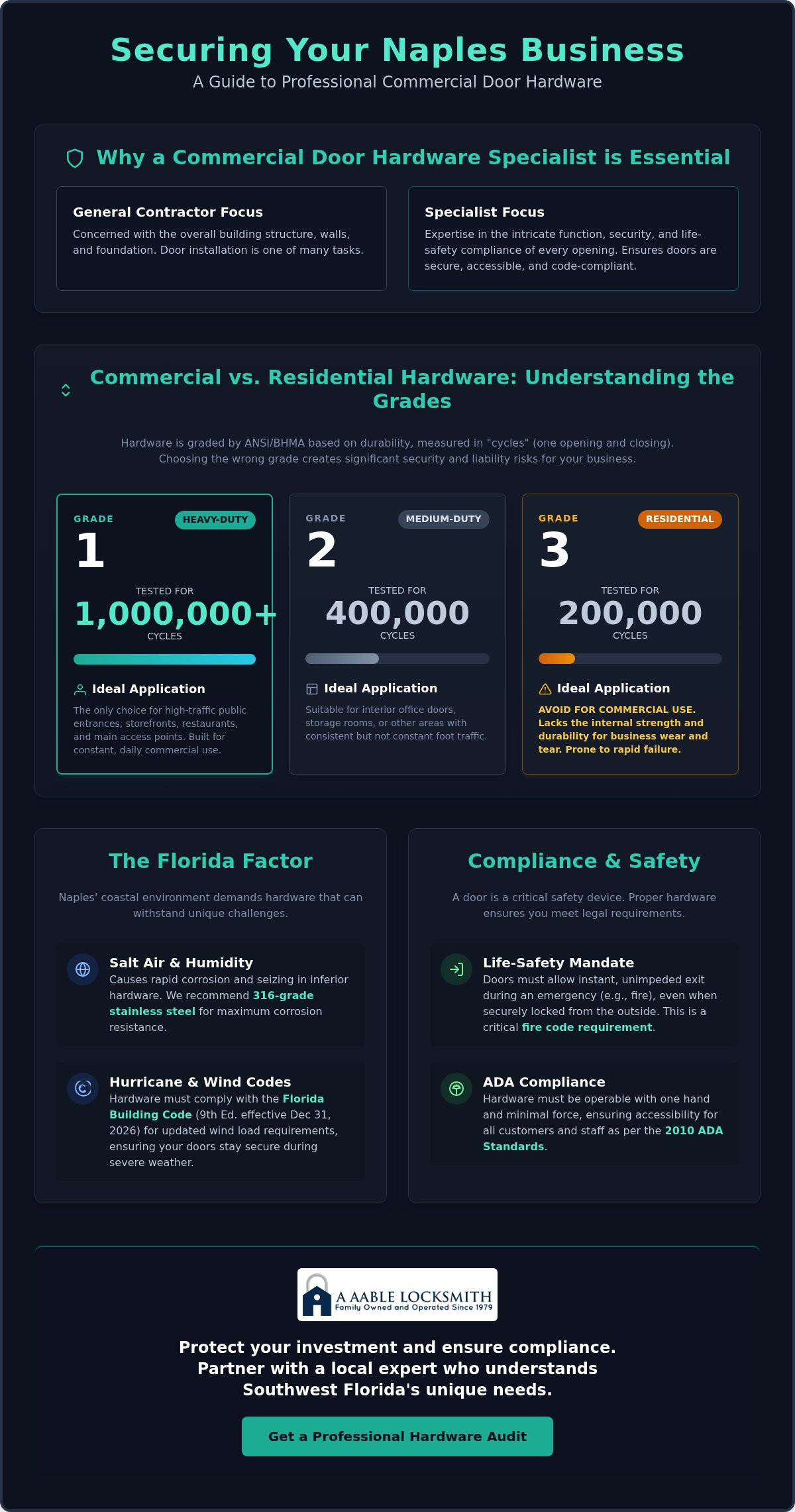
- Grade 1: This is the heavy-duty gold standard. It is tested to withstand 800,000 to 1,000,000+ cycles. It is the only choice for primary storefront entrances and high-traffic public buildings.
- Grade 2: Designed for medium-duty use, these are tested for 400,000 cycles. They work well for interior office doors or storage rooms where traffic is consistent but not constant.
- Grade 3: These are residential or light-duty locks tested for 200,000 cycles. They should be avoided for almost all commercial applications as they lack the internal strength to survive business wear and tear.
Security Features of High-Grade Hardware
High-grade hardware offers protection that goes far beyond simple durability. Commercial Grade 1 cylinders are engineered with hardened steel pins and specialized sidebars to resist picking, drilling, and bumping. We also utilize through-bolting techniques during installation. This process involves bolting the hardware through the door itself rather than just into the surface, making it nearly impossible for an intruder to rip the handle off with a crowbar. These robust physical protections are often paired with digital keypad locks to provide audit trails, allowing you to see exactly who accessed your building and when.
Properly graded hardware also ensures you stay in alignment with the ADA Standards for Accessible Design. These regulations require specific lever shapes and opening forces that lower-grade hardware often cannot maintain over time. If you are unsure if your current setup meets these rigorous standards, a commercial door hardware specialist can perform a thorough assessment to ensure your business remains both secure and compliant.
Navigating Life-Safety Codes and ADA Compliance
For a business owner in Naples, the hardware on your front door represents much more than a simple lock. It is a critical component of life-safety compliance. The fundamental mandate of life-safety codes is that a door must always allow for immediate egress. Even if a door is securely locked from the outside to prevent unauthorized entry, anyone inside the building must be able to exit without a key, special knowledge, or extraordinary effort. Failing to meet these standards doesn't just result in a failed fire marshal inspection. It creates significant legal liability for Florida property owners if an emergency occurs. A commercial door hardware specialist ensures your facility balances these strict safety requirements with your need for security.
Professional standards in this field are guided by organizations like the Door and Hardware Institute (DHI), which emphasizes the technical precision required for code-compliant installations. This expertise is especially vital for fire-rated doors. You cannot simply drill a hole in a fire door to install a new lock without potentially voiding its fire rating. Every component, from the hinges to the latching mechanism, must be tested and listed to work together to contain smoke and flames during a fire.
Exit Devices and Panic Bars
Panic bars, also known as exit devices, are legally required in assembly, educational, or high-hazard buildings once occupancy reaches a specific threshold, typically 50 people or more. There are different styles depending on your door type. A "rim" device is common for single doors, while "surface vertical rod" devices are often used on double doors to secure them at both the top and bottom. For fire-rated openings, maintaining "positive latching" is essential. This means the hardware must automatically catch and hold the door shut during a fire to prevent it from swinging open due to pressure changes. We provide expert door closer and exit device service to keep these complex systems in perfect working order.
Accessibility Standards for Florida Businesses
The 2010 ADA Standards for Accessible Design have made traditional door knobs nearly extinct in commercial spaces. Hardware must be operable with one hand and without tight grasping, pinching, or twisting of the wrist, which is why lever handles are now the standard. Beyond the handle itself, we must also consider the closing speed. A door that slams shut too quickly can injure patrons or block wheelchair access. Regulations generally require that a door takes at least five seconds to close from an open position of 90 degrees to a point 12 degrees from the latch. Our role as a commercial door hardware specialist is to calibrate these closers and ensure your thresholds and clear width requirements are met, providing a safe and welcoming environment for every customer who walks through your doors.
The Florida Factor: Salt Air, Humidity, and Hurricane Codes
Naples and Marco Island offer some of the most beautiful coastal views in the world, but for a business owner, that salt air is a constant adversary. It doesn't take long for the "Florida Factor" to set in. Salt air and relentless humidity act as corrosive agents that can seize a standard lock cylinder or cause a door closer to leak in just a few seasons. As a commercial door hardware specialist, we spend a significant portion of our time addressing the damage caused by our local environment. It's not enough to just buy a "heavy-duty" lock. You need hardware specifically engineered to survive the Southwest Florida coastline.
Humidity also plays a role in door alignment. When moisture levels fluctuate, doors can swell or frames can shift slightly. This often leads to doors that won't latch or locks that require "jiggling" to operate. For businesses with electronic components or digital keypads, this moisture can lead to short circuits or premature battery failure if the housing isn't properly sealed. A steady, reliable maintenance schedule is the only way to keep these systems functioning in our tropical climate.
Corrosion-Resistant Finishes
Selecting the right finish is just as important as the lock's internal grade. We often recommend 316-grade stainless steel or hardware treated with Physical Vapor Deposition (PVD). PVD is a high-tech coating process that creates a nearly indestructible bond at the molecular level. This allows manufacturers to offer lifetime finish warranties even in salt-heavy environments. While oil-rubbed bronze might look elegant, it is often a "living finish" that will rapidly pit and turn green when exposed to the gulf breeze. We help you choose materials that maintain their professional appearance without the constant threat of "pitting" or frozen mechanisms.
Wind-Load and Impact Requirements
In Florida, your door hardware is also part of your hurricane defense system. The upcoming 9th Edition of the Florida Building Code, set to take effect on December 31, 2026, adopts the stricter ASCE 7-22 wind load standard. This expands the 160 mph impact-resistant envelope to many areas within five miles of tidal waters. This means your hinges and latching points must be strong enough to keep the door in the frame during extreme pressure changes. A commercial door hardware specialist ensures that heavy-duty hinges or "continuous hinges" are used to distribute wind load evenly across the entire frame. We coordinate closely with local building inspectors to ensure every entryway meets these essential life-safety requirements.
If your storefront hardware is showing signs of rust or struggling to latch correctly, don't wait for a storm to test its strength. Contact us for a professional door closer and exit device service to ensure your business is ready for anything the Florida coast throws its way.
Why A Aable Locksmith is Your Naples Hardware Partner
A Aable Locksmith isn't just another service provider. We've been a steady part of the Southwest Florida landscape since 1979. As a third-generation, family-owned business, we've watched Naples evolve from a quiet coastal town into a bustling hub for retail, hospitality, and luxury HOAs. This deep history means we don't just understand locks; we understand the specific buildings they're attached to. When you hire a commercial door hardware specialist from our team, you're gaining an advisor who knows which hardware sets were used in a specific office park twenty years ago and how to upgrade them to modern standards today.
Our process is built on precision and local knowledge. We begin with a thorough security survey of your property to identify vulnerabilities, from aging closers to non-compliant exits. We then coordinate a plan that utilizes premium brands known for their longevity, such as Schlage, Yale, and Von Duprin. By choosing high-quality materials and professional installation, we help you avoid the cycle of frequent repairs that often plagues businesses using inferior components.
45+ Years of Community Trust
There is a distinct advantage to working with a specialist who knows the building histories in Bonita Springs and Estero. We've spent decades working alongside local contractors and business owners, building a reputation for reliability that a national call center simply can't match. When you call us, you talk directly to a master craftsman who takes personal pride in the safety of your facility. We understand the nuances of local codes and the unique environmental pressures of our region. For more detailed insights on how we manage these requirements, you can read more about our Commercial Door Hardware Naples FL: Local Standards and Security Guide.
Comprehensive Commercial Solutions
We provide a full suite of services designed to keep your business running smoothly. Whether you need a simple lock rekeying after a staff transition or the implementation of a complex high-security system, we have the tools and expertise to handle the job. We offer same-day service and free estimates for local businesses because we know that a broken door closer or a malfunctioning exit device can't wait. Our goal is to ensure your property remains secure, your patrons stay safe, and your hardware operates with the effortless precision you expect. Ready to secure your property? Contact A Aable Locksmith today to speak with a dedicated commercial door hardware specialist and schedule your survey.
Building a Secure Future for Your Storefront
Your business is a significant investment that deserves more than a standard lock from a retail shelf. We've explored how the right ANSI Grade 1 hardware handles the high-traffic demands of a Naples retail space and how specialized finishes withstand our brutal salt air. Whether you're preparing for the 2026 Florida Building Code updates or ensuring your entryways meet the 2010 ADA Standards, the guidance of a commercial door hardware specialist is your best defense against liability and premature wear. It's about finding the perfect balance between robust security and easy access for every patron who walks through your doors.
At A Aable Locksmith, we've been serving the Naples community since 1979. As a family-owned, third-generation business, we bring a level of craftsmanship and local knowledge that is deeply rooted in our neighborhood. We are specialists in industry-leading brands like Von Duprin, Sargent, and Falcon, ensuring your property is equipped with hardware that lasts. It's time to stop worrying about failing latches or corroded hinges. Secure Your Business with a Professional Hardware Consultation and let us help you build a safer, more reliable environment for your team and your customers. We're here to help you protect what you've built.
Frequently Asked Questions
What is the difference between a locksmith and a commercial door hardware specialist?
A commercial door hardware specialist focuses on the complex interplay between security, life-safety codes, and accessibility, whereas a general locksmith typically handles basic residential lockouts and rekeying. Specialists are trained to manage high-cycle hardware and ensure every component meets strict building regulations. They act as consultants who audit your facility for code violations and engineer entryway systems that protect both your property and its occupants.
Are panic bars required for all commercial buildings in Florida?
Panic bars are not required for every building, but they are mandatory for assembly, educational, or high-hazard occupancies once a specific capacity is reached. In Florida, this threshold is generally 50 people or more. These devices ensure that anyone can exit the building instantly in an emergency without needing a key or special knowledge. A specialist can help you determine if your specific occupancy load requires these life-safety devices.
How often should commercial door closers be serviced in high-traffic areas?
Commercial door closers in high-traffic Naples businesses should be inspected and serviced at least once or twice a year. Constant use and fluctuating Florida temperatures can cause hydraulic fluid to thin or seals to wear down, affecting the closing speed. Regular adjustments ensure your doors continue to meet ADA opening force requirements and prevent the hardware from slamming, which can damage the door frame and the closer itself.
Can I install residential smart locks on my business's front door?
It is best to avoid residential smart locks for business storefronts because they aren't designed for high-traffic cycles. Residential units typically utilize lighter materials and lack the internal strength to handle hundreds of daily operations. Instead, we recommend commercial-grade digital keypad lock installation, which provides the durability needed for a business environment along with sophisticated audit trails and multiple user codes that residential models often lack.
What does 'Grade 1' hardware actually mean in terms of durability?
Grade 1 signifies the highest level of durability and security as defined by ANSI/BHMA testing standards. This hardware is built to withstand 800,000 to over 1,000,000 cycles, making it the standard for high-traffic public buildings and storefronts. Beyond cycle counts, Grade 1 components are also tested for impact resistance and weight-bearing capacity, ensuring they don't fail under the stress of heavy use or attempted forced entry.
Why is my commercial door slamming or not closing all the way?
A door that slams or fails to latch is usually suffering from a misadjusted closer or worn-out hinges. High-traffic doors often shift over time, causing the latch to miss the strike plate entirely. If the closer's hydraulic valves are out of sync, the door may close too fast or lack the final latch speed needed to secure the opening. Professional service can usually recalibrate these components to restore smooth, safe operation.
Do you provide commercial hardware services in Marco Island and Bonita Springs?
Yes, we proudly provide expert commercial hardware services throughout Naples, Marco Island, and Bonita Springs. Our team has deep roots in these communities and understands the specific building histories and environmental challenges found in each area. Whether you manage a beachfront resort on Marco or a retail shop in Bonita, we bring the same level of master craftsman expertise to every project to ensure your business remains secure.
How does salt air affect my business's door locks and hinges?
Salt air acts as a corrosive agent that can rapidly pit metal surfaces and cause internal lock mechanisms to seize. In coastal areas, salt crystals accumulate inside cylinders and hinges, creating friction that leads to premature failure. This is why a commercial door hardware specialist recommends 316-grade stainless steel or PVD finishes, which are engineered to resist these harsh environmental conditions and maintain their functionality and appearance over time.


